
Last updated September 20, 2026
Free on-site gate assessment - hinges, posts, and your LiftMaster or Nice gate operator checked before anything is quoted
The assessment is free and the quote is the invoice.



 Before
 After
After Before
 After
After Before
 After
AfterGate Repair Warning Signs: A Dallas Homeowner’s Reference Guide
Here’s the thing most Dallas homeowners learn the expensive way: gates don’t fail suddenly. They fail gradually, in ways that are easy to dismiss because they don’t stop the gate from working. A grinding noise on Tuesday becomes background noise by Friday. A gate that opens a little slower becomes the new normal. A remote that only works from 20 feet instead of 60 gets filed under “it’s always been like that.” By the time the gate stops moving entirely, the $180 tension adjustment or $95 hinge bushing has become a $900 motor replacement. This guide covers the warning signs we look for on every Gate Repair services call in Dallas, organized by what you can see, hear, and measure.
We’re Vance Gate Repair Dallas home, and we’ve repaired enough gates across this city to know that the most expensive repair call is never the first symptom. It’s the sixth, after the homeowner adjusted to the grinding, the slow open, the occasional reversal, and the remote that stopped working from the street. This reference is built around the observable signals, not the diagnoses. You don’t need to know what a limit switch is to notice that your gate now takes four seconds longer to close than it did in March.
Quick Answer
Gate repair warning signs in Dallas fall into five observable categories: changes in sound, changes in timing, mid-travel reversals, visible wear on moving parts, and declining remote range. Any one of these signals, logged consistently over two weeks, gives a technician enough information to diagnose the problem before arriving. In Dallas specifically, the combination of clay-heavy soil movement, summer heat cycling, and long irrigation seasons accelerates hinge wear and operator misalignment faster than homeowners expect.
Table of Contents
- Sounds That Mean Something: Mapping Noise to Components
- Timing Changes: The Diagnostic Tool Hiding in Plain Sight
- What a Mid-Travel Reversal Is Actually Telling You
- Visual Wear You Can Spot Without Tools
- How Dallas Soil and Climate Accelerate Gate Wear
- Documenting Warning Signs: The Log That Saves You Money
- Common Mistakes to Avoid
- When to Call a Professional
- Frequently Asked Questions
- The Bottom Line
BeforeAfterSounds That Mean Something: Mapping Noise to Components
A gate in good mechanical condition is quiet. Not silent, but quiet enough that you stop noticing it after the first month. When a homeowner can describe a specific noise from a specific part of the gate, that description is already a diagnostic shortcut. Here’s what different sounds typically indicate, based on thousands of gate repair calls across Dallas:
- A dry metallic squeal or chirp on startup almost always traces to a bearing that has lost its grease. It’s most common on chain-drive operators, and it’s usually resolved by servicing or replacing the bearing before it scores the shaft. Ignore it long enough and the bearing seizes, which strips the chain or burns the motor.
- A rhythmic thump or slap while the gate moves points to a chain or belt that has stretched beyond spec. The tensioner can only compensate so far. Once the chain is loose enough to slap the rail, it’s also wearing the sprocket teeth unevenly.
- A heavy, laboring hum from the motor, especially on a swing gate, often means the operator is working against misalignment. The motor isn’t failing. The hinges or the mounting post have shifted, and the motor is pushing harder to compensate. This is the sound of a $180 alignment issue becoming a $700 motor replacement if left unaddressed.
- A sharp crack or pop when the gate starts or stops is frequently a broken weld, a cracked hinge leaf, or a gate leaf that has dropped and is catching on the latch or the ground. This is the warning sign that tends to precede a gate falling off its hinges entirely.
One thing worth noting about Dallas specifically: the freeze-thaw cycles we get in January and February, mild as they are, do real work on weld joints. A weld that survived ten summers will crack after two or three winters if moisture has been working into a pinhole. If you hear a pop that wasn’t there before, especially after a cold snap, get it looked at before the next one.
Timing Changes: The Diagnostic Tool Hiding in Plain Sight
Here’s a technique we teach homeowners who call us for the second or third time on the same gate: time it. A gate operator is designed to move your gate at a specific, consistent speed. When that speed changes, the change is measurable before it’s audible or visible. You don’t need any tools beyond a phone stopwatch.
How to establish a baseline:
- Time your gate from fully closed to fully open three times, on three different days, at roughly the same temperature. Record all three numbers.
- Now time it from fully open to fully closed the same way. Opening and closing speeds can differ slightly by design, so track them separately.
- Once you have your baseline, check it once a month. A change of more than one and a half seconds in either direction is meaningful.
A gate that is getting slower is usually telling you one of three things: the operator is working harder (misalignment, lubrication breakdown, or a failing capacitor), the power supply to the operator is degrading (a loose connection, corroded wire, or an undersized transformer), or the mechanical components are binding (hinges that have shifted on the post, a wheel off its track, debris in the rack).
A gate that is getting faster is rarer but more dangerous. It usually means a mechanical failure has removed resistance from the system. A counterbalance spring on a heavy iron gate, for example, might snap and the gate will slam open. If your gate is suddenly faster, call a technician that day. A gate moving faster than its design speed can injure someone and will damage the operator’s internal gearing in short order.
In our experience with gate motors and openers in Dallas, timing changes are the single most underused diagnostic signal. Homeowners notice sounds because sounds are intrusive. They don’t notice an 11-second open becoming a 14-second open because nothing interrupts them. But that three-second difference is a technician’s early warning.
What a Mid-Travel Reversal Is Actually Telling You
A gate that reverses direction before it finishes opening or closing is not being stubborn. It’s responding to an input. The control board on every modern gate operator is programmed to stop and reverse when it detects something wrong. The question is which input triggered it, and the answer determines whether this is a $40 fix or a $600 rebuild.
There are three causes, ranked by typical repair cost:
| Cause | What’s Happening | Typical Dallas Repair Range |
|---|---|---|
| Obstruction sensor (photo-eye) misalignment | The infrared beam across the gate opening isn’t reaching its receiver. The operator assumes something is in the path and reverses. | $60-$140 |
| Force setting too low | The operator’s sensitivity threshold is set so tight that normal resistance from wind or minor track wear trips the reversal. | $95-$175 |
| Mechanical binding | Hinges, wheels, or the gate track itself are creating enough physical resistance that the motor draws more current than its force limit allows and reverses. | $180-$600 depending on the binding point and what’s worn |
The photo-eye is the most common culprit and also the easiest to misdiagnose from the ground. A beam can be off by two inches and everything looks fine to the naked eye. A force setting that was fine in January might suddenly trip in March when Dallas wind gusts push against a solid wood or wrought-iron gate panel and increase motor load beyond the threshold. We carry LightForce and Safe-T-Beam equipment on the truck because these sensors account for a large share of residential gate reversals across the metro.
What matters for the homeowner is this: a reversing gate is not a quirky personality trait. It’s a signal that something in the safety system has a problem. Fix the signal, not the symptom.
Visual Wear You Can Spot Without Tools
You don’t need to open the operator housing or pull the cover off the control board to do a meaningful visual inspection. Some of the highest-value warning signs are visible from your driveway on a Sunday afternoon. Here’s what to look for, and what each item tells you:
- Hinge leaf gap changes. Look at the gap between the moving gate leaf and the fixed post. If the gap at the top is wider than at the bottom, or vice versa, the gate has dropped. That’s a hinge wear or post-movement signal. In Dallas, this happens faster than in drier markets because expansive clay soil under the posts contracts and swells with moisture, shifting post footings by fractions of an inch each year.
- Powder residue around the hinge barrel or wheel axles. Fine gray or brown powder is often metal-on-metal wear, either from a bushing disintegrating or a bearing running dry. It will appear before the squeal becomes constant.
- Track wear on slide gates. Run your eyes along the V-track or the rail. A shiny, polished groove where the wheels ride is normal. A groove that looks like a canyon, with visible steps or ridges, is not. The wheels are grinding the track instead of rolling on it.
- Limit-switch cam scoring or flat spots. On operators with external limit switches, visible scoring on the cam lobe means the switch has been riding hard against it. This shows up as inconsistent stop positions before it becomes a full failure.
- Light rust streaking from bolt heads. This is often cosmetic, but streaking that runs down from a load-bearing bolt can indicate the bolt is loosening and allowing moisture into threads it should be sealing.
If you spot any of these, photograph it. We’ll explain why that photograph is worth money in the next section.
How Dallas Soil and Climate Accelerate Gate Wear
Most gate repair guides are written as if every gate lives in the same conditions. They don’t. The same gate installed in Dallas will wear differently than the same gate installed in Phoenix or Seattle, because the environment does different things to metal, electronics, and the ground underneath.
Dallas sits on expansive clay soil, the kind that swells when wet and shrinks when dry. Your gate posts are footed into that soil. Through a typical year’s wet spring and dry August, the soil around each footing moves. One post might shift an eighth of an inch. That doesn’t sound like much, but at the latch point of a 14-foot gate leaf, an eighth-inch shift at the post becomes half an inch or more of misalignment at the edge. The latch misses. The gate binds. The operator works harder. The cycle compounds.
Summer heat does its own work. Operators mounted in unshaded boxes or posts on west-facing exposures can see internal temperatures over 140 degrees in August. Capacitors age faster in those conditions. Control boards with electrolytic capacitors that might last 10 years in a shaded installation can fail in five. We see this regularly on swing-gate operators in neighborhoods like Preston Hollow and Lake Highlands where mature tree cover is sparse and afternoon sun is direct.
Winter temperature swings matter too. Dallas doesn’t get the kind of deep freezes that shatter welds in Minnesota, but we get enough freeze-thaw cycling that hairline cracks in powder coating and seam welds open up, take on moisture, and begin oxidizing from the inside. The result is rust in places homeowners don’t see until a hinge cracks through or a gate leaf drops.
Documenting Warning Signs: The Log That Saves You Money
Here’s a scenario we see every month. A homeowner calls and says, “My gate has been doing something weird for about a year.” We ask what it was doing. They say, “It makes a noise sometimes. And it’s slow. And one time it opened by itself.” That description gives us almost nothing to work with. We have to start from zero, which means more diagnostic time, which means more cost than necessary.
Contrast that with the homeowner who keeps a simple log. A notes app, a spreadsheet, a piece of paper taped inside a cabinet door. It doesn’t need to be elaborate:
- Write down the date and time of any unusual sound, behavior, or failure.
- Describe it in one or two sentences. “Gate made a grinding noise when opening, lasted about 4 seconds, stopped after it was fully open.”
- If it’s a timing issue, log the stopwatch readings as described earlier in this guide.
- If it’s a sound or visible change, take a photo or a short video. Video with audio captures what a still photo can’t.
- If a remote stops working, note which one, when, and from how far away it last worked.
This log is worth actual money when you get a repair quote. A technician who can see two months of documented timing drift, hear a recorded bearing noise, and look at progressive hinge-gap photographs can often diagnose the specific failure before touching the gate. That shortens the diagnosis time and lowers your bill. It also eliminates the most expensive kind of diagnostic work: the kind where a technician has to recreate an intermittent problem that isn’t happening on the day of the visit.
We log everything on our end too. Every Gate Repair in Dallas visit we complete includes a photo record of what was found, what was adjusted, and what was installed. It’s the same documentation Adrian Vance relied on in commercial access-control work starting in 2014, and it means the next technician who works on your gate, whether that’s us or someone else, doesn’t have to guess.
Common Mistakes to Avoid
The most expensive mistakes in gate repair aren’t the ones technicians make. They’re the ones homeowners make in the weeks and months before the technician is called. Here are the ones we see most often in Dallas:
- Lubricating the gate to “fix” a grinding noise. Spraying a lubricant on a hinge or bearing that is already damaged does nothing to reverse the wear. It makes the noise quieter for a few days, which simply masks the signal that would have told you and your technician which part is failing. The part keeps wearing.
- Adjusting force or sensitivity settings to stop a reversal. The force setting exists to protect people and the gate itself. Raising it so the gate powers through whatever is binding turns a $180 repair into a $600 one, and puts anyone near the gate at risk.
- Ignoring a remote that only works at close range. This is often the earliest warning sign of an antenna or receiver problem in the operator. By the time the remote stops working entirely, the issue may have affected other control-board components as well.
- Assuming a swing gate that hangs lower on one side is “just old.” Gates don’t sag with age the way fence boards do. A sagging gate is a structural signal: hinges are failing or a post is moving. Both get worse, not better.
- Waiting until the gate stops working to look for replacement parts. Some components, especially for older Linear, Viking, and FAAC operators, are no longer in active production. If your operator is a model that’s been discontinued, knowing that before it fails gives you the option of sourcing a part proactively rather than facing a full replacement on a broken gate.
- Deleting the photographs you took of the warning sign. The photo you took in March of the rust streaking on the bottom hinge is evidence in September when the hinge cracks. Keep the photos. They help the technician understand the progression.
When to Call a Professional

Some gate maintenance is genuinely safe for a homeowner to handle: keeping the track clear of debris, hosing off accumulated dirt, checking that nothing is leaning against the gate. But warning signs that involve electricity, springs, cables, or a gate that’s too heavy to move by hand are not DIY territory. High-tension gate springs, especially on heavy iron and steel swing gates, store enough energy to cause serious injury if they let go unexpectedly. The operator, the limit switches, the safety edges, and the control board all carry live current, and the photo-eye alignment affects the safety reversal that protects your family and pets. If your gate has any of the warning signs in this guide, and especially if it’s reversing mid-travel or making noise from the motor housing, have a trained technician look at it.
Vance Gate Repair Dallas offers free estimates throughout Dallas. Call (469) 299-5902 and a live person will answer, day or night.
Frequently Asked Questions
Most residential gate repairs in Dallas fall between $150 and $650, depending on what’s failed, as detailed in our How to Hire a Gate Repair Contractor in Dallas: A Step-by-Step Guide. A photo-eye realignment or force-setting adjustment typically runs $60 to $175, a hinge replacement or tension adjustment runs $180 to $450, and an operator or motor replacement generally starts around $650 and can exceed $1,500 for larger swing gates with high-duty operators. Every quote we provide is written, itemized, and handed to you before any work starts, so the number on the quote is the number you pay. Call (469) 299-5902 for an exact quote on your gate, free.
A gate that opens normally but refuses to close, or closes most of the way and then reverses, usually means the obstruction sensor (photo-eye) isn’t getting a clear beam. The beam may be misaligned, a lens may be dirty, or the sensor may be failing. In some cases the close limit switch is set wrong and the gate doesn’t know it reached the closed position. A technician can diagnose which one it is in under an hour. If your gate is doing this in Dallas right now, we can be out the same day in most cases.
Yes. Vance Gate Repair Dallas has live people answering the phone 24 hours a day, seven days a week, and we dispatch background-checked, uniformed technicians for same-day gate repairs across Dallas. No dispatch fee to come out and give you a written diagnostic and price before any work begins. Call (469) 299-5902 any hour.
Declining remote range almost always points to an antenna problem on the operator’s receiver side, not a battery problem in the remote. Look for a damaged or pinched antenna wire, or a receiver that’s been partially unplugged. On some BFT and FAAC operators the receiver module can also drift off frequency over time. A technician can test the transmitter and receiver and identify which side is at fault.
Standard residential gate hinges in the Dallas climate typically last 7 to 12 years depending on gate weight, exposure, and maintenance. Heavier steel or full-cover gates, gates on west-facing exposures without shade, and gates that are opened and closed more than 10 times a day will be at the shorter end of that range. Proper lubrication and prompt attention to any gap changes or powder residue around the hinge barrel will extend hinge life meaningfully.
We write the price before any work starts, every time, no exceptions. That’s Clause 1 of the Haven Standard we operate under, and it applies whether the job is a $95 sensor alignment or a full gate installation. No verbal estimates, no “we’ll see when we get in there,” no invoice at the end that doesn’t match the paper you signed. You’ll get a written scope, a written price, and a photo record of what we did. That’s the standard on every Vance Gate Repair Dallas job.
The Bottom Line
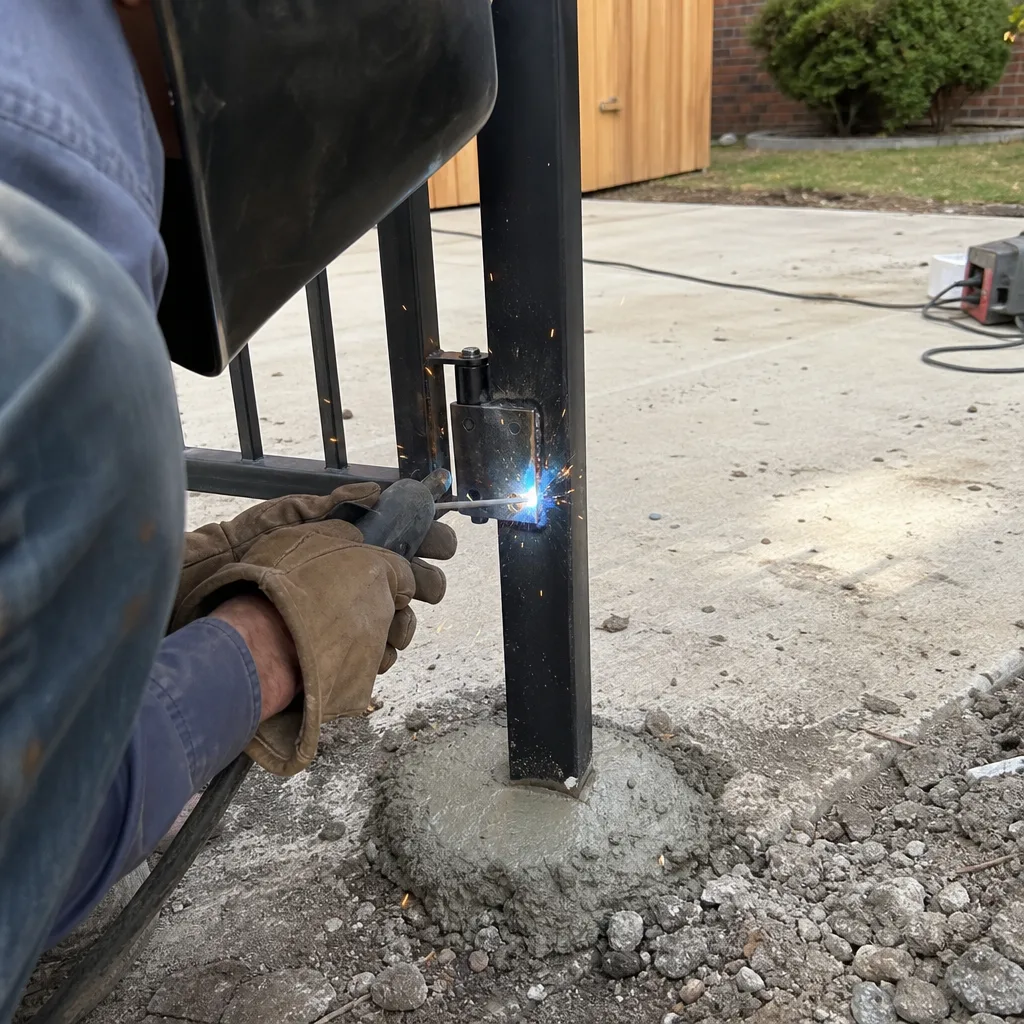
Gate warning signs are observable, measurable, and worth documenting. A Dallas homeowner who notices a change in sound, timing, reversal behavior, visual condition, or remote range, and who logs that change consistently, is ahead of almost every other homeowner who will call a repair company this year. The habit of logging and photographing warning signs is the same habit that makes the eventual repair cheaper, faster, and more accurate, and you’ll find more guides & resources on our blog to help maintain your gate. The gate doesn’t care whether you’re a technician. It’s warning you anyway.
Contact Vance Gate Repair Dallas
If you’ve noticed one of the warning signs in this guide, or if your gate has been “acting a little off” for a while and you’re not sure what it means, call us. We’ll schedule a free estimate, send a background-checked technician with a name and photo provided before arrival, and hand you a written price before any work starts. That’s how we’ve handled more than 22,000 gates repaired and installed since 2014, and it’s how every job goes, from a simple sensor fix to a full operator replacement. Call (469) 299-5902 any time, day or night. A live person answers.
Written by Adrian Vance, Owner at Vance Gate Repair Dallas, serving Dallas since 2014.