
Last updated September 20, 2026
Free on-site gate assessment - hinges, posts, and your LiftMaster or Nice gate operator checked before anything is quoted
The assessment is free and the quote is the invoice.


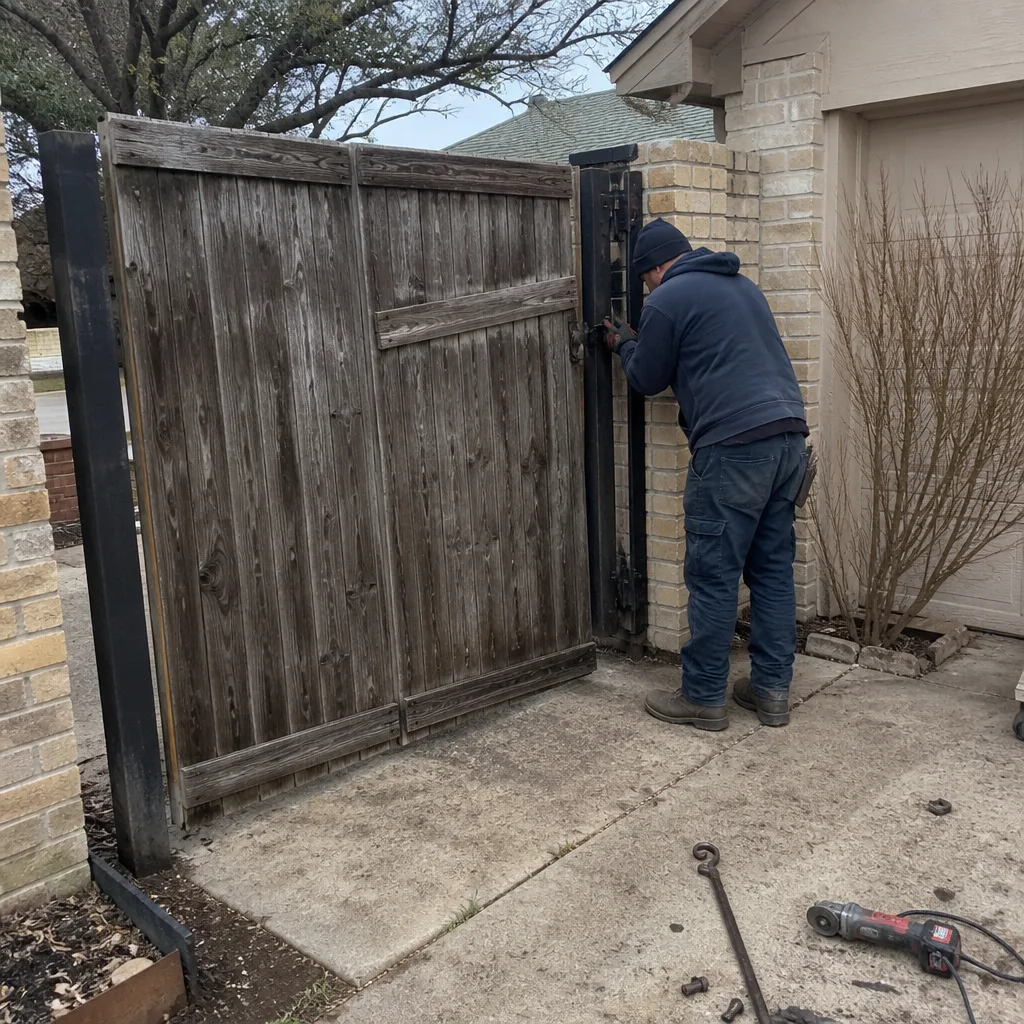 Before
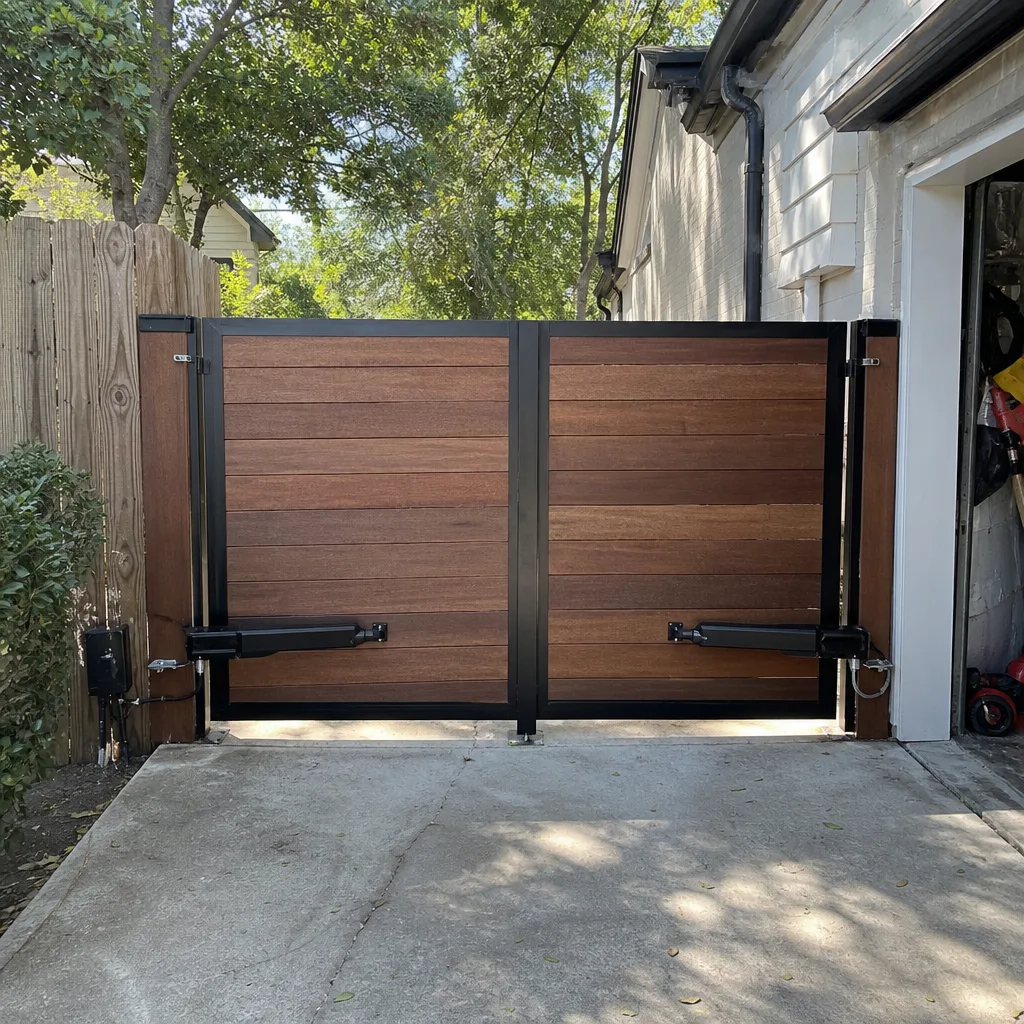 After
After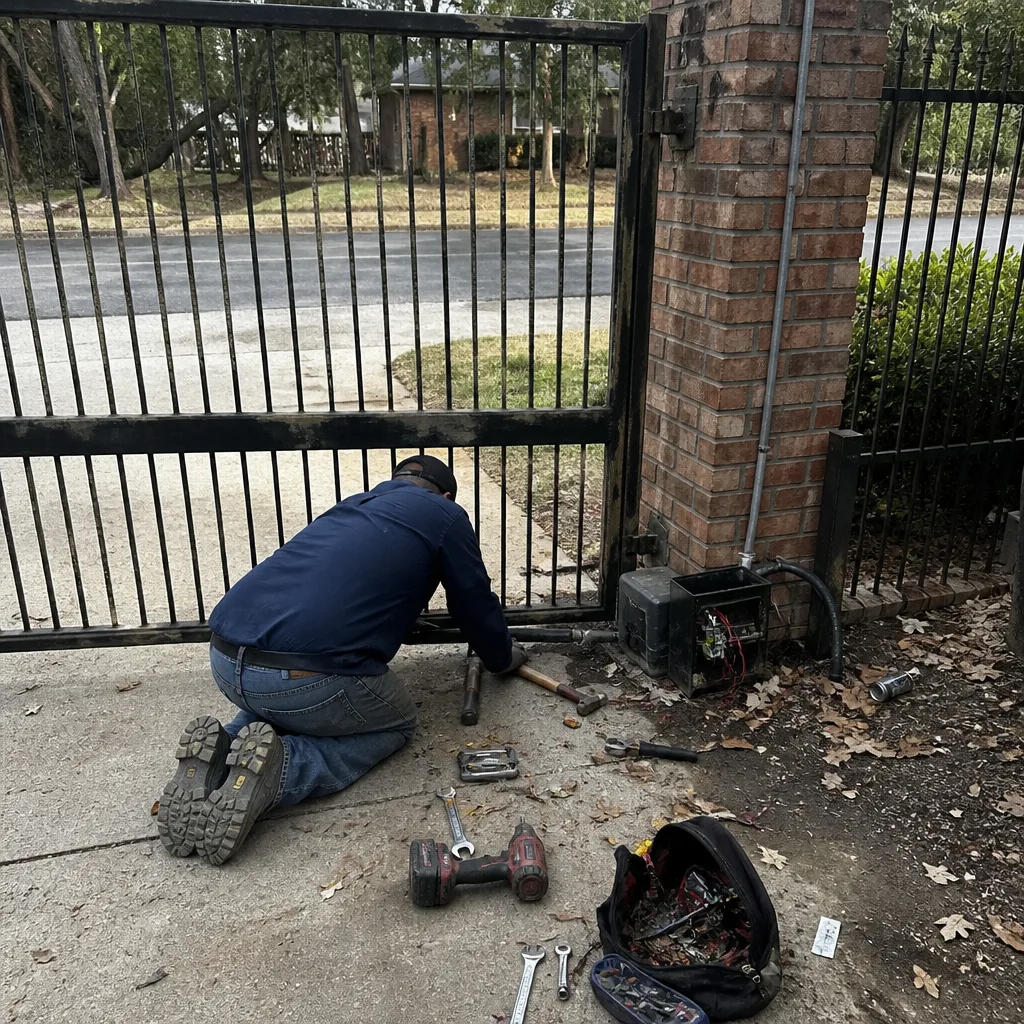 Before
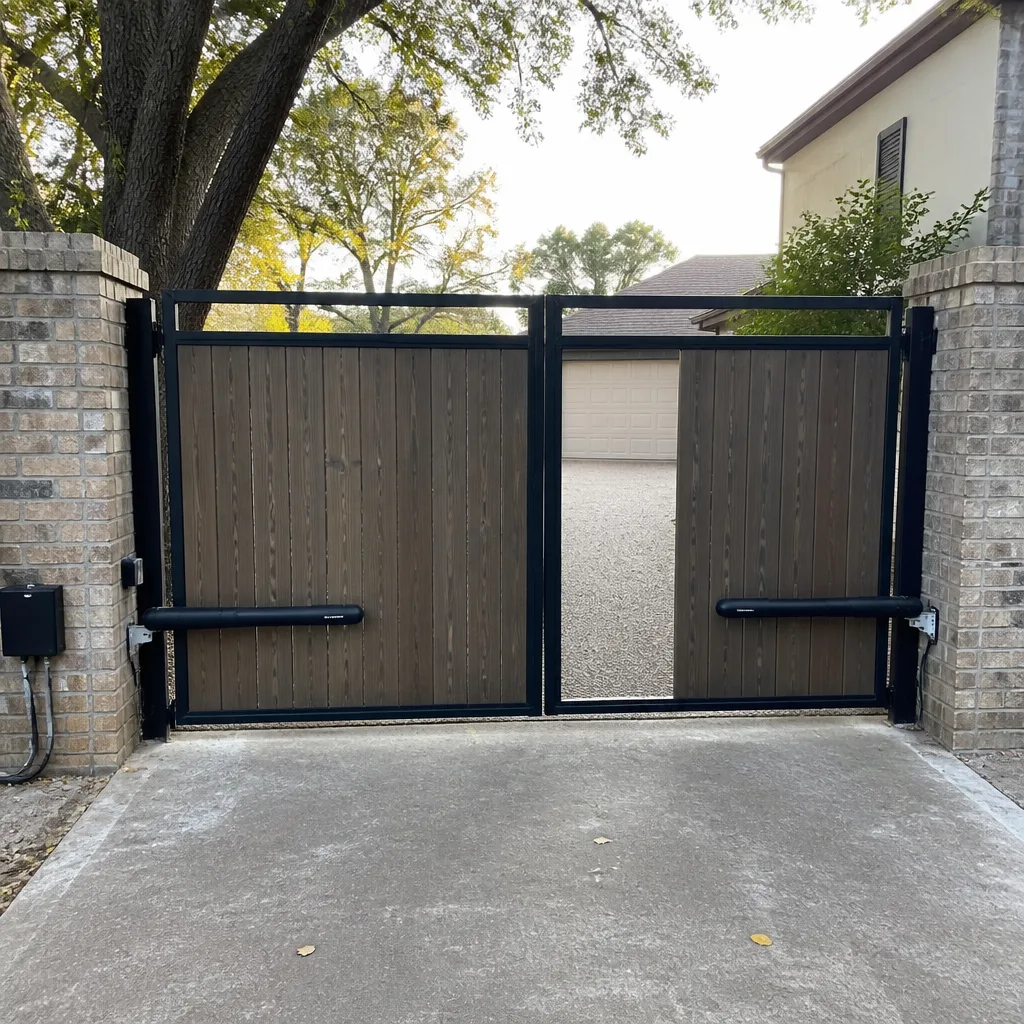 After
After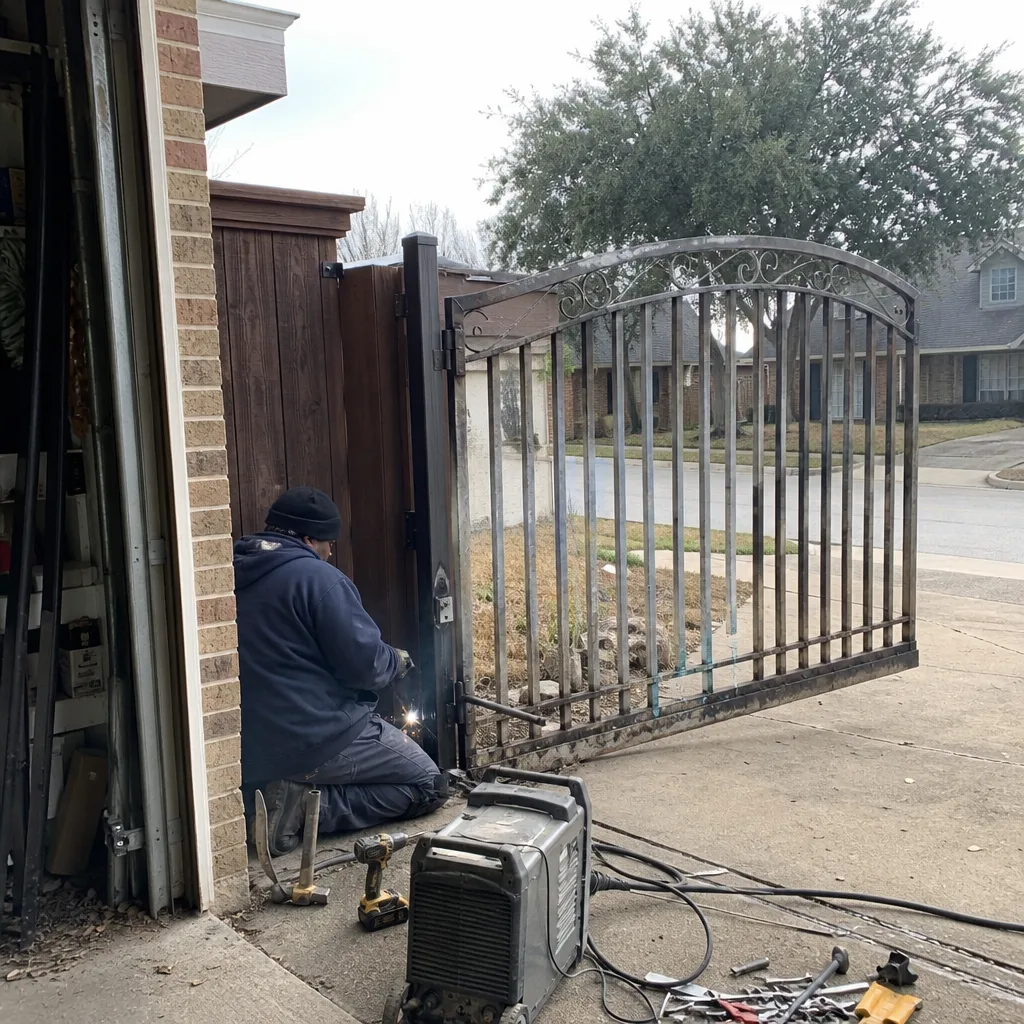 Before
 After
AfterDIY vs Professional Gate Repair: The Dallas Homeowner’s Decision Guide
Here’s a number most Dallas homeowners never hear: a failed DIY gate opener installation costs, on average, $200 to $400 more to correct than the original repair would have cost, because the technician has to undo the work before starting the real job. That’s the counterintuitive truth behind this guide. The DIY-versus-professional question isn’t a yes-or-no decision. It’s a line-item decision. Some gate repairs are genuinely reasonable for a careful homeowner to attempt, and others carry consequences that turn a $150 savings into an $800 steel-reinforcement bill. We’ll walk through the distinction task by task, with Dallas-specific costs, code requirements, and the exact tools that make the difference.
Quick Answer
DIY gate repair in Dallas is appropriate for three tasks: lubrication, sensor realignment, and remote reprogramming. Everything involving the motor’s internal electronics, the gate’s structural frame, or the low-voltage wiring inside the operator housing belongs in professional Gate Repair hands. If the repair requires opening the motor cabinet, lifting the gate off its hinges, or running new wire, the risk outweighs the savings every time. For Dallas homeowners, the practical answer is a hybrid: handle the three safe tasks yourself, call a technician for the rest.
Table of Contents
- The Task-by-Task Split: What’s Truly Safe to DIY
- Texas Low-Voltage Licensing: What It Means for Your Gate
- Two Safe Electrical Checks Anyone Can Do With a $25 Multimeter
- What a Failed DIY Repair Costs in Dallas: The Undo Bill
- How Documentation Changes the DIY Calculus
- Dallas Climate and Gate Wear: What Breaks First
- DIY vs Professional Cost Comparison: The Real Numbers
BeforeAfterThe Task-by-Task Split: What’s Truly Safe to DIY
Most gate problems in Dallas fall into one of seven categories. Some are genuinely approachable with basic tools and patience. Others require equipment, training, and in some cases, a state license. Let’s work through the list systematically.
Task 1: Lubrication, safe to DIY. Gate hinges, wheel bearings on slide gates, and chain drives all need periodic lubrication with a lithium-based or silicone-based grease. This is the single highest-value DIY task on a gate. A can of white lithium grease costs about $7 at any Dallas hardware store, and ten minutes of work can add years to your hinge life. The mistakes to avoid: using WD-40 on hinges (it’s a solvent, not a long-term lubricant), and lubricating the gate track on a slide gate (it attracts dust and grit that destroys the rollers).
Task 2: Sensor alignment, safe to DIY. Photo-eyes get bumped out of alignment by mowers, sports equipment, and Texas wind. Realigning one typically requires loosening two screws, aiming the beam until the indicator light turns solid, and retightening. It’s a fifteen-minute job. What makes it DIY-safe: there’s no high voltage involved, and there’s no way to “almost align” a photo-eye and still have it fail disastrously. It either works or it doesn’t.
Task 3: Remote programming, safe to DIY. Adding a new remote to a LiftMaster, Linear, or Ghost Controls opener usually involves pressing a learn button and the remote button in sequence. The steps differ by brand, but nearly every manufacturer publishes a two-minute instructional video. The risk is minimal, and the parts involved are cheap enough that a mistake costs $20 to $35 to replace.
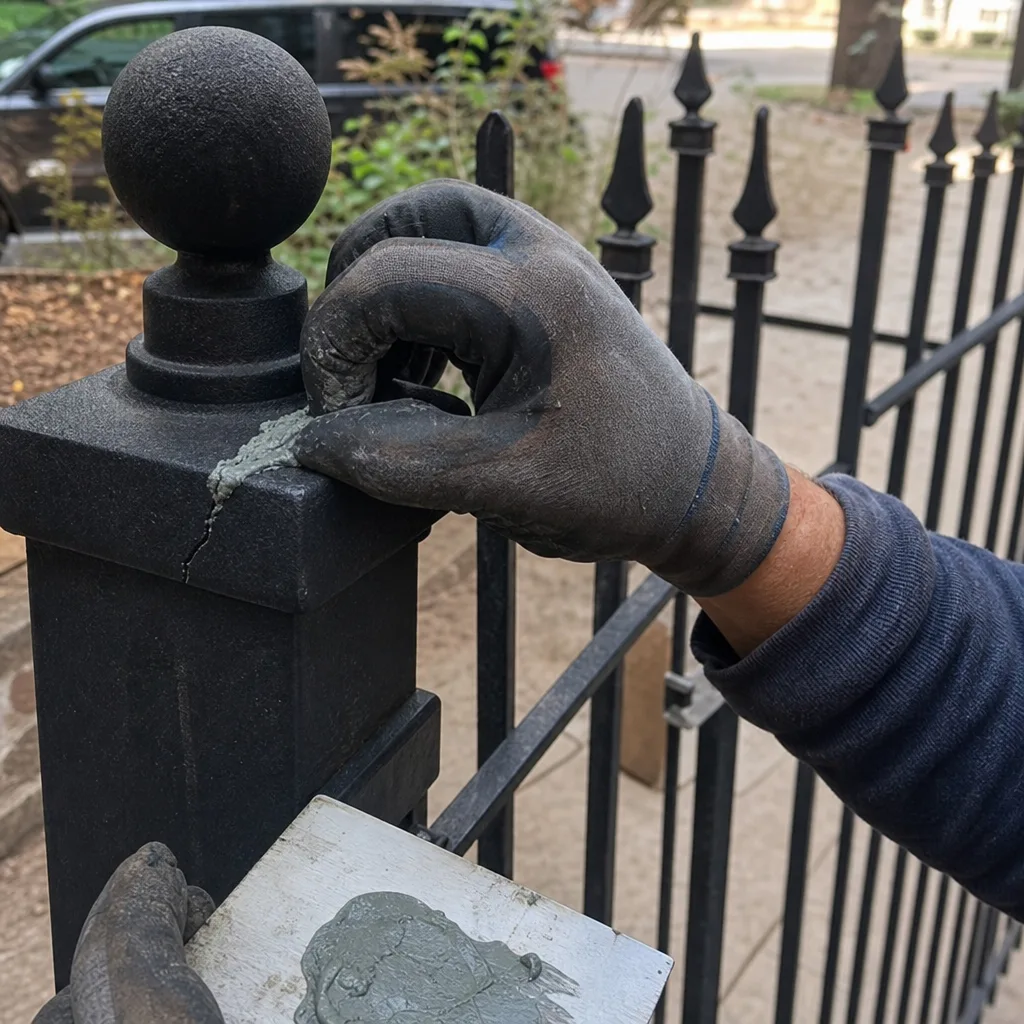
Task 4: Hinge replacement, NOT DIY. Gate hinges on any gate over 4 feet tall involve the full weight of the gate. Removing a hinge means the gate has to be properly supported first. A gate that slips off its supports can crush a hand, a leg, or worse. And on many Dallas properties built before 2010, the gate post surrounding that hinge has already begun to degrade from soil expansion. What should be a simple bolt swap becomes a concrete-jacket reinforcement. We see it consistently: homeowners in Lake Highlands who attempt a hinge replacement discover the post is cracked and the job just tripled in scope.
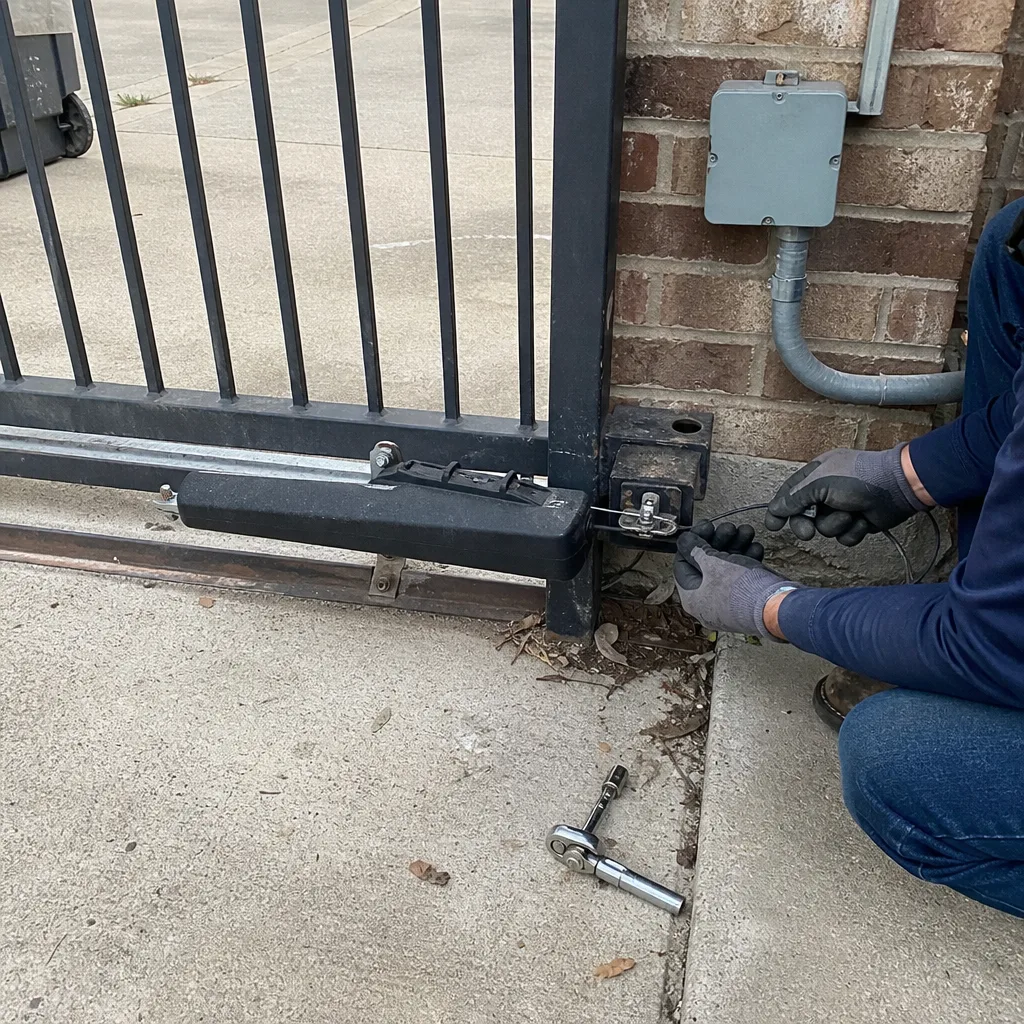
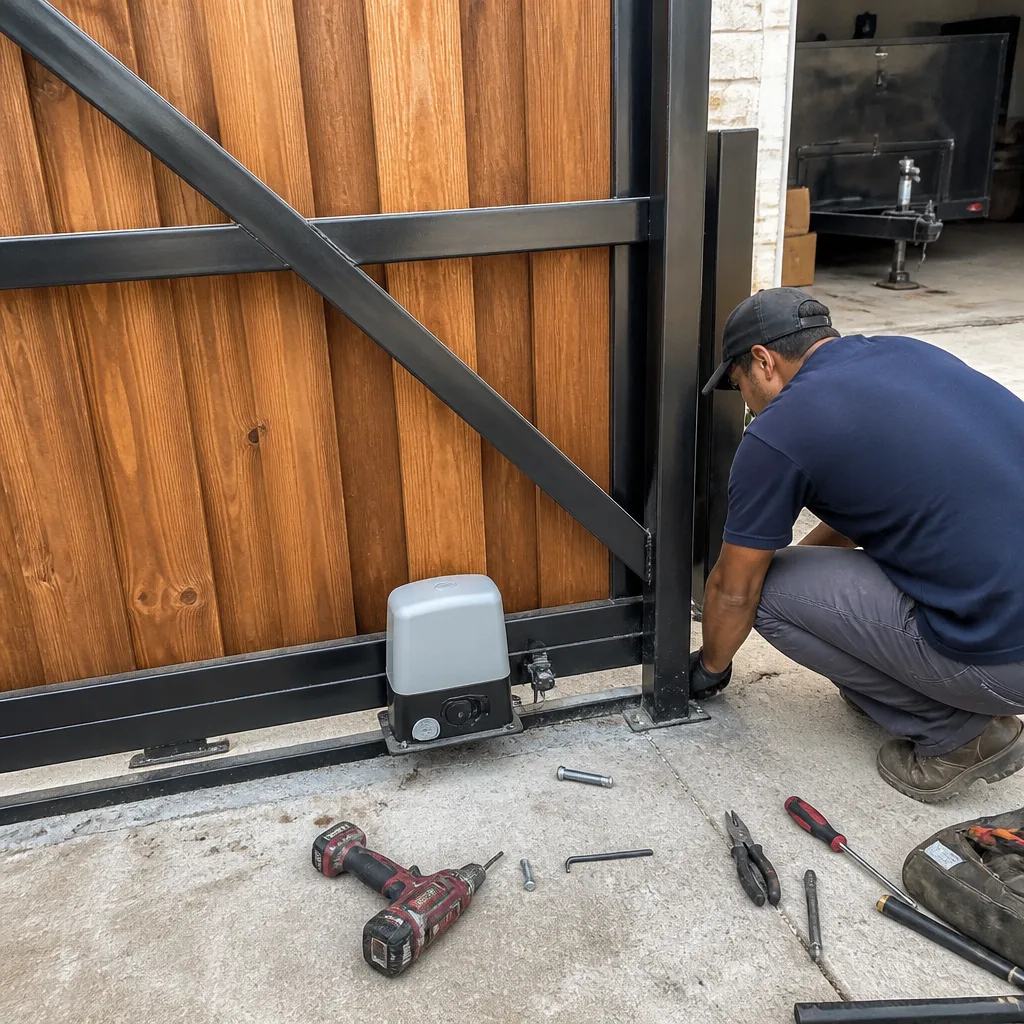
Task 5: Operator (motor) replacement, NOT DIY. This is the job that creates the most expensive “undo bills.” A residential gate operator costs between $800 and $2,400 depending on brand and type. Installing one involves setting limit switches (which tell the motor where to stop), adjusting force sensitivity (which tells the motor when to reverse), and wiring the unit into either a line-voltage or low-voltage circuit. Get the limit switch wrong and the gate drives itself into the post at full torque until either the gate bends, the post breaks, or the operator burns out. A $1,200 DIY job becomes a $1,900 gate frame repair.
Task 6: Control board replacement, NOT DIY. Gate control boards are static-sensitive, brand-specific, and often require programming that isn’t in the manual. A Viking technician can replace a board in about 45 minutes. A homeowner reading forums for three evenings and then taking a guess might get lucky once. But the catastrophic failures are genuinely expensive, especially on swing gates, where a board that fails to reverse the gate on an obstruction will simply drive through whatever is in the way.
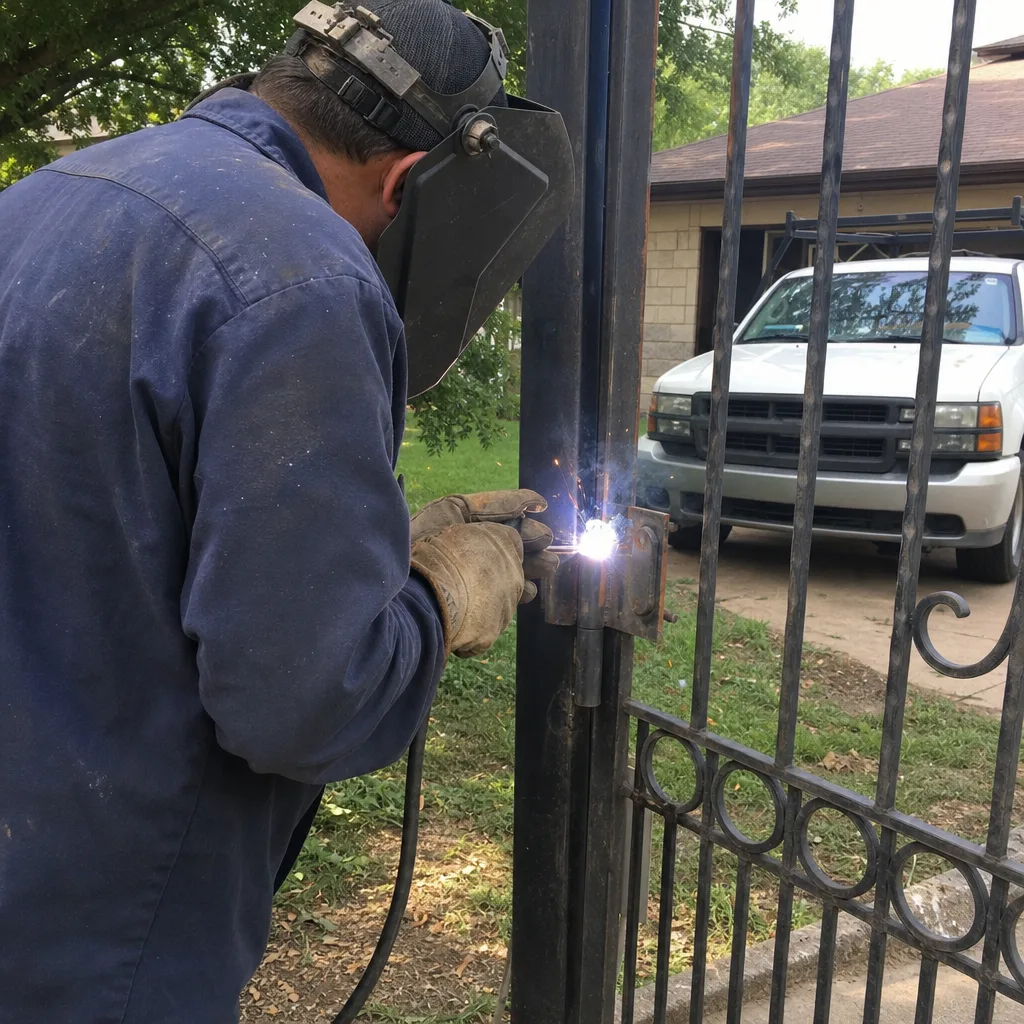
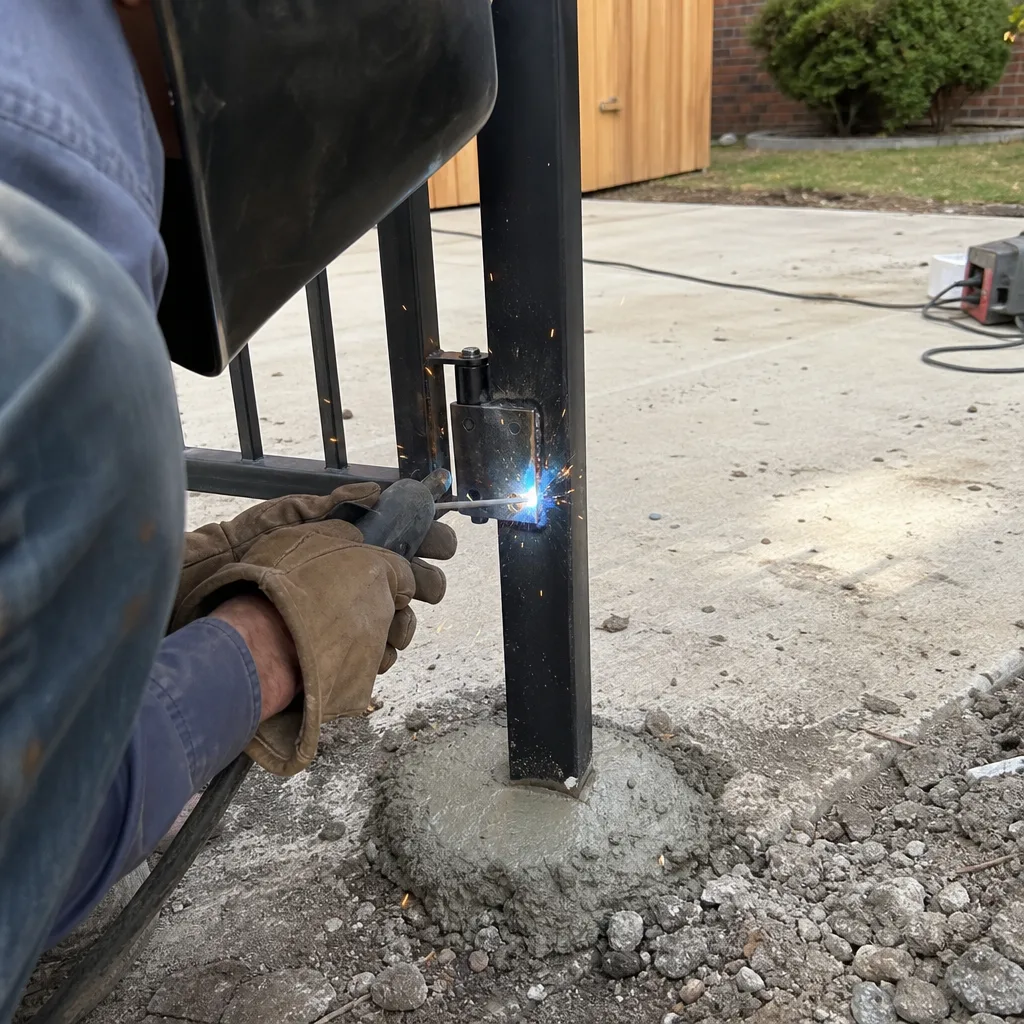
Task 7: Hinge welding, NOT DIY. Aside from the equipment and skill required, Dallas building code and your home insurer both care about how that weld was performed. A bad weld fails without warning, and a gate that fails at the hinge can easily weigh 300 to 600 pounds. We’ve never seen a homeowner-welded hinge that a inspector would sign off on.
The pattern: the safe DIY tasks are the ones where failure is immediately visible and cheap. The dangerous ones are where failure is silent until the damage is expensive.
Texas Low-Voltage Licensing: What It Means for Your Gate
This is the part most “DIY vs professional” guides skip, and it’s the part that matters in Dallas. Texas is one of the states that regulates low-voltage electrical work at the state level. Gate openers run on low-voltage DC current inside the operator, but they are connected to line voltage at the disconnect switch. Here’s the distinction that matters for a homeowner:
Homeowners in Texas are legally allowed to perform electrical work on their own primary residence without a license, including low-voltage and line-voltage work, provided the work is done to code. That’s the legal reality. But “allowed to” and “should” are different conversations. The Texas Department of Licensing and Regulation requires a licensed electrical contractor for any low-voltage work performed for compensation on someone else’s property. When you hire a professional gate company in Dallas, their technicians work under either an electrical contractor license or as part of a company that holds one.
What this means for the DIY calculus: if you install a gate operator yourself and the wiring is later found to be non-compliant, the cost of correction falls entirely on you. If a licensed contractor installs it and the wiring fails inspection, the correction is their responsibility. That’s not a warranty promise. That’s the structure of the licensing system.
For Dallas code specifics, the city adopts the National Electrical Code (NEC) with local amendments, and Dallas Development Services performs electrical inspections on new installations. Gate operators installed within 10 feet of a pool or spa face additional bonding requirements under NEC 680. If your Dallas property has a pool anywhere near the gate, that compliance question is worth asking before anyone touches the wire.
Two Safe Electrical Checks Anyone Can Do With a $25 Multimeter
A multimeter is the single most useful diagnostic tool a homeowner can own, and the two checks below are genuinely safe to perform on a gate system without specialty training. Neither involves removing the operator cover or touching line-voltage connections.
Check 1: Battery voltage on a solar or backup-battery operator.
- Set the multimeter to DC voltage, typically marked “V” with a solid line over a dashed line.
- Locate the battery terminals, usually behind a small access panel on the side of the operator, not the main cover.
- Place the red probe on the positive terminal and the black probe on the negative terminal.
- A healthy 12-volt battery reads between 12.6 and 13.2 volts at rest. A reading below 11.8 means the battery is significantly depleted. Below 10.5 usually means a dead cell.
This check answers a lot of “my gate won’t respond” calls before they happen. In Dallas, the summer heat kills gate batteries quickly, often in two to three years rather than the five a manufacturer claims.
Check 2: Sensor continuity on a photo-eye.
- Remove the photo-eye from its bracket (usually two small screws, and the unit unplugs).
- Set the multimeter to continuity mode, typically marked with a sound-wave or diode symbol.
- Touch the probes to the two terminals on the photo-eye’s connector.
- A working photo-eye will beep or show near-zero resistance when the beam path is clear, and go silent or show OL (over-limit) when the beam is blocked.
A photo-eye that shows continuity regardless of whether the beam is blocked is stuck closed. One that never shows continuity is dead. Both are $20 to $45 parts. Either way, you’ve just diagnosed a problem that most homeowners pay a service call to discover.
Both checks are safe because they deal with battery-level voltage or a disconnected component. Never use a multimeter on live AC line voltage without training, full stop. That’s the line where DIY becomes dangerous.
What a Failed DIY Repair Costs in Dallas: The Undo Bill
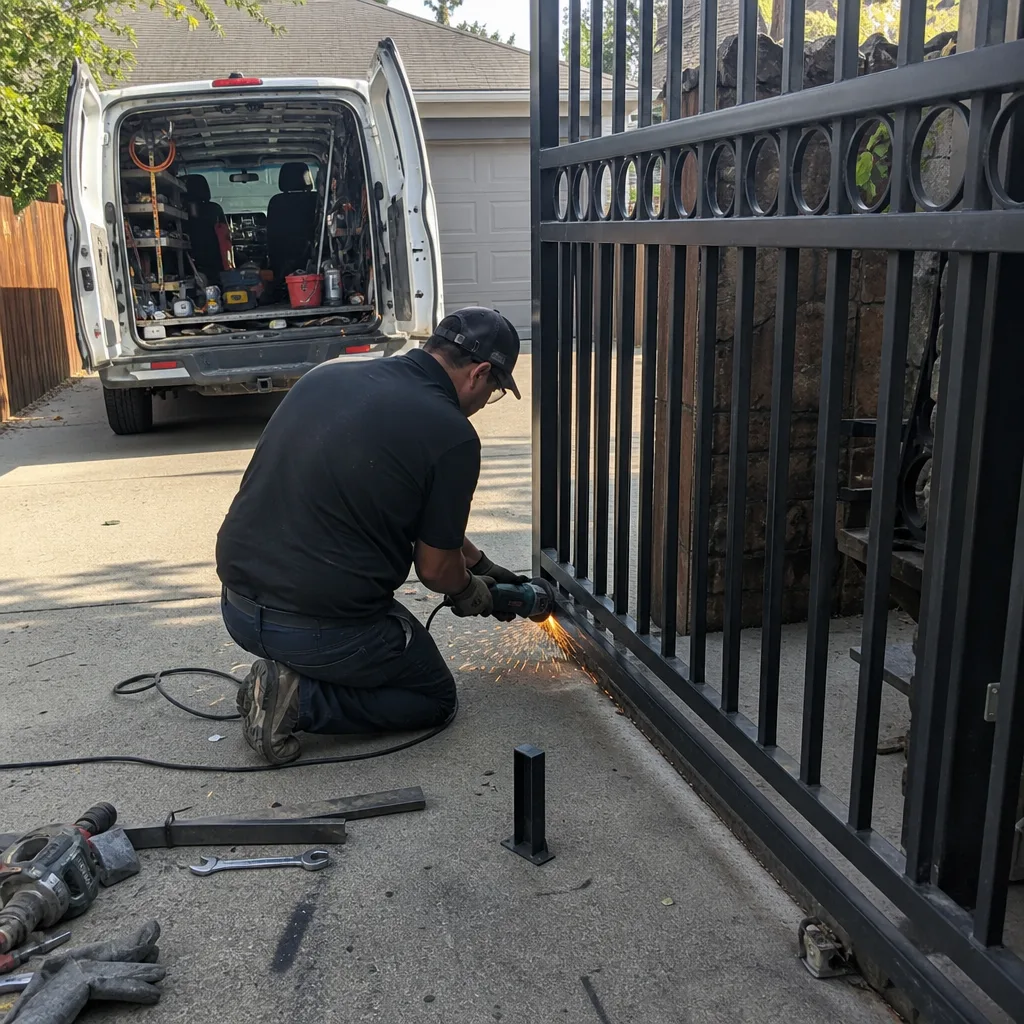
When a technician arrives to correct a DIY attempt, the first hour is typically spent undoing the homeowner’s work before the actual repair begins. That’s not punitive. It’s the practical reality of working on a system where the previous attempt changed the starting conditions.
Here’s what that undo bill looks like in Dallas in 2026, based on the rates at independent gate companies across the metro area (for full pricing context, see our Gate Repair Cost Breakdown: The Dallas Homeowner’s Reference for 2026):
- Undiagnosed electrical work: When a homeowner has replaced parts blindly, the technician has to test every component back to spec before identifying the actual fault. Time added: 45 to 90 minutes. Cost added: $75 to $160.
- Stripped or wrong-size hardware: When a homeowner used SAE bolts on a metric bracket (or vice versa), the threads are now damaged. Recommending a bolt-hole repair and re-tap: $40 to $85 per hole.
- Incorrect limit-switch setting: A gate that runs past its travel stop can bend the gate frame, snap a hinge, or damage the operator’s internal stop. Frame straightening on a standard steel gate in Dallas runs $250 to $600. A new hinge weld: $85 to $150.
- Failed operator installation: The most expensive undo category. If an operator was wired incorrectly and the board is damaged, the replacement board is $150 to $400, plus the original installation time is lost. Total added cost above the correct installation: $300 to $700.
For Dallas homeowners, the practical takeaway is this: if the repair involves more than two connections and a single part, the DIY attempt is as likely to add cost as to save it. The break-even point for most gate work, when you factor in parts, tools, time, and the risk of an undo bill, sits right around $150 in savings. Above that, the professional is cheaper in expected value.
How Documentation Changes the DIY Calculus
There’s one variable that changes the entire DIY equation, and almost no one considers it: documentation.
If you attempt a repair and photograph every step, label every wire before you touch it, and write down what you did, a professional can recover your work. They can see what was there before, what you changed, and where to pick up. The undo bill becomes a continuation bill, which is meaningfully cheaper.
If you attempt a repair and don’t photograph anything, the technician is starting blind. They can’t tell whether the loose wire was loose before you started or whether you pulled it loose. They can’t tell whether the stripped screw was already stripped. They have to test everything from zero, which is exactly the same amount of labor as if they’d been called in the first place, except now the gate is in a worse state than it was.
This is why Vance Gate Repair Dallas has adopted a documentation standard on every job we perform. Every visit includes a photographed record of what was found, what was adjusted, and what was replaced. The customer gets the photo log before the technician leaves. The next technician who touches that gate doesn’t have to guess. That’s the commercial-grade documentation habit Adrian Vance brought from access-control work into residential driveways.
If you’re going to DIY, steal the habit. Take photos of every connection before you undo it. Label every wire with masking tape. Write down the sequence of what you did, even if it’s just notes on your phone. If it works, you’ve saved money and documented your own work. If it doesn’t, you’ve cut the undo bill roughly in half. Documentation is the difference between a $150 lesson and a $400 lesson.
Dallas Climate and Gate Wear: What Breaks First
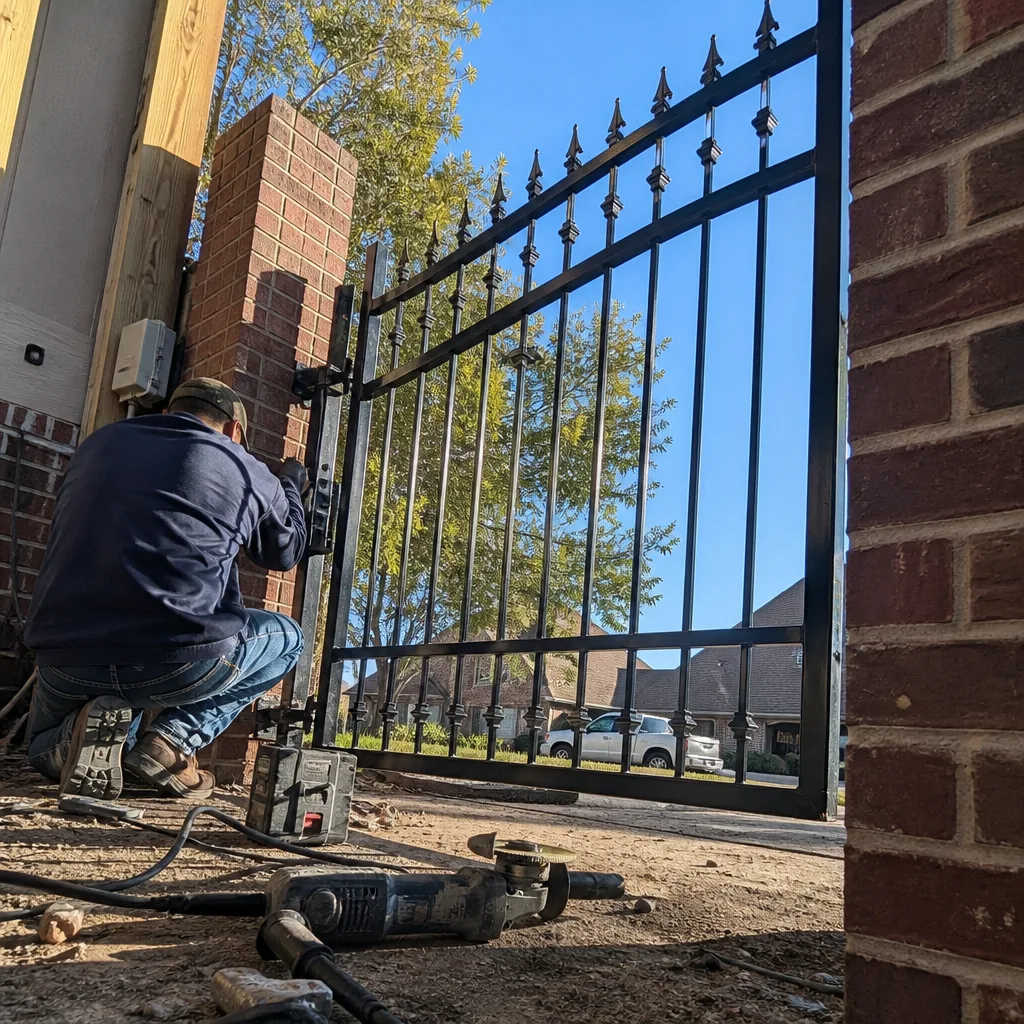
Dallas has a climate that punishes gates in specific, predictable ways. Understanding the failure patterns helps you anticipate which repairs are coming and which ones are immediate.
Heat, the battery killer. Dallas regularly hits 100 degrees in July and August, and gate operators in direct sun run at ambient temperatures of 130 degrees or higher inside the cabinet. Backup batteries and solar batteries degrade about 40% faster here than they would in a temperate climate. A 12-volt battery that lasts five years in Seattle lasts three in Dallas. We replace more heat-dead batteries in August than in every other month combined.
Clay soil, the post shifter. Much of Dallas sits on expansive clay soil. The same soil that causes foundation movement also moves gate posts. A post that shifts half an inch over a dry summer changes the gate’s travel geometry, which stresses the hinge plates and puts the operator out of alignment. This is why a gate that worked perfectly in May suddenly binds or scrapes in September. The soil, not the gate, is the culprit.
Wind, the force-multiplier. North Texas wind loads on a solid panel gate can exceed 30 pounds per square foot during spring storms. A gate that was marginally balanced becomes dangerously unbalanced in a 40 mph gust. This is a strong argument against trying to squeeze the last year out of aging hinges and rollers, and a key reason to follow a Gate Repair Maintenance Checklist for Dallas Homeowners. In Dallas, the margin between “working” and “dangerous” is narrower than the gate’s age makes it seem.
Rain and humidity, the circuit-board stressor. Dallas gets about 37 inches of rain per year, often in intense bursts. Gate control boards that aren’t properly sealed or that sit in a cabinet with failed gaskets take on moisture, and moisture plus heat equals failed capacitors. It’s one of the most common failure points we see in older operators across Preston Hollow and East Dallas.
DIY vs Professional Cost Comparison: The Real Numbers
Here are the typical costs for common gate repairs in Dallas, comparing equipment-and-parts-only DIY costs against professional turnkey pricing. The professional prices assume a licensed Dallas gate company, not a handyman without gate-specific experience.
| Repair | DIY Parts Cost | Professional Cost (Dallas, 2026) | Failure Risk of DIY |
|---|---|---|---|
| Hinge and track lubrication | $7-$15 | $45-$85 (service visit) | Very low |
| Photo-eye realignment | $0 (no parts needed) | $60-$110 (service visit) | Very low |
| Remote reprogram or replace | $20-$65 (new remote) | $45-$85 (remote supplied by company) | Very low |
| Battery replacement (12V backup) | $35-$70 (battery only) | $95-$160 (battery and installation) | Moderate (wrong battery type) |
| Hinge replacement (single hinge) | $25-$60 (hinge only) | $150-$300 (including post inspection) | High (load-bearing) |
| Control board replacement | $150-$400 (board only) | $280-$550 (board and programming) | High (static damage, programming) |
| Operator replacement (swing) | $800-$1,800 (unit only) | $1,400-$2,900 (unit, install, settings) | Very high (limit switches, wiring) |
| Hinge weld repair | Not realistic to DIY | $85-$250 (per weld point) | Very high (structural) |
The pattern in the right column is the whole thesis of this guide. The $7 jobs are DIY. The $25 jobs are DIY if you’re careful. The $150-and-up jobs are where failure gets expensive. If the last time you saw the inside of a gate operator was when you bought the house, the line between those categories is probably earlier than you think.
For swing-gate operators specifically, most replacements in Dallas run between $1,600 and $2,700 installed, depending on whether the existing arm bracket is in good shape and whether the gate is properly balanced. On BFT and Linear units, availability is good in the Dallas market and parts can usually be sourced same-week. Viking and Ghost Controls tend to be special-order, which pushes the timeline out a few days.
Common Mistakes to Avoid

- Using the wrong lubricant. WD-40 on gate hinges is the most common DIY mistake in Dallas. It cleans and then it dries out, leaving the hinge worse than before. Use white lithium grease or silicone spray.
- Replacing a remote before checking the battery. A surprising number of “dead remotes” are just dead 3-volt coin cells. A $2 battery beats a $35 remote.
- Tightening the limit switch “a little more” without understanding what it does. Limit switches define the gate’s end-of-travel point. Small adjustments make big differences, and overtightening leads directly to a gate that tries to push through its stop post.
- Assuming the motor is dead before checking battery voltage. In the heat of a Dallas summer, a solar operator’s battery can fail suddenly. Before ordering a new motor, check the battery with the multimeter method above.
- Ignoring the gate’s balance when replacing an operator. An unbalanced gate destroys new operators. The operator is not designed to fix a gate that’s too heavy or binding; it’s designed to move a balanced gate efficiently. About one in three operator replacements in Dallas requires hinge or balance work first.
- Forgetting that Dallas soil moves. The gate that scrapes the ground in September may not be a “warped gate.” It may be a shifted post from clay soil contraction. And the fix is often a shim adjustment, not a welding bill.
- Not photographing the wiring before disconnecting the old operator. This is a $50-to-$150 mistake every time. Photograph first. Disconnect second. Never the reverse.
When to Call a Professional
Call a professional when the repair involves the motor’s internal components, any part of the gate’s structural frame, or any wiring that requires opening the operator cabinet (see our more guides & resources for help deciding). Call when the gate is too heavy to lift alone (and don’t test that by hand, because the moment of testing is when the injuries happen). Call when the problem is intermittent, because intermittent problems usually mean failing electronics or failing wiring, and those don’t improve with patience.
Call if you’ve already attempted the repair and you’re not sure what went wrong. A good Dallas gate company will recover the work if you documented it, and a documented recovery is far cheaper than a mystery diagnosis. We’ve made a practice of this: bring us photos and notes from your attempt, and we’ll start from where you stopped instead of from zero.
Gate Repair in Dallas is what we do every day, and Gate Motor & Opener in Dallas is the category where DIY failures are most expensive. For anything beyond the three safe tasks, the math favors the professional. And if you’ve read this far, you’re probably in exactly that position now. Call Vance Gate Repair Dallas at (469) 299-5902 for a free estimate, and a technician will give you a written price before any work starts.
Frequently Asked Questions
Most Dallas gate repairs run between $85 and $550 depending on the fault. A service visit for a minor issue like sensor alignment or lubrication is $85 to $150. A control board replacement is $280 to $550. A full operator replacement is $1,400 to $2,900. The price is quoted and written before any work starts, so you’ll know your exact cost upfront. Call (469) 299-5902 for an exact quote, and the estimate is free.
You can, legally, on your own primary residence, but you shouldn’t. The limit-switch setup procedure is the failure point: get it wrong and the gate drives into the stop post at full torque, bending the frame and destroying the new operator. A professional installation in Dallas costs $1,400 to $2,900, and it includes the setup, the wiring, and the liability if the settings are wrong. Call (469) 299-5902 for a written price before you decide.
For the three safe DIY tasks, you need a can of white lithium grease, a Phillips head screwdriver, a small flathead, and a multimeter (about $25). That kit handles lubrication, photo-eye alignment, and the two safe electrical checks. You do not need a socket set, a drill, or anything that opens the operator cabinet, and if a task seems to require those tools, it’s probably not a DIY task.
Twice a year in Dallas, once before summer and once after the first fall cold front. The heat and clay soil in North Texas put extra stress on batteries and hinges, so semi-annual checks catch problems early. A typical maintenance visit includes lubrication, sensor alignment, limit-switch verification, battery testing, and a written record of what was done.
For most residential gate and operator installations in Dallas, no building permit is required for the gate itself, but electrical permits may be required for new power runs to the operator location, particularly if new line-voltage wiring is being installed. If the gate is within 10 feet of a pool or spa, additional bonding requirements apply. The installing contractor should know which codes apply to your specific property. If they can’t answer that question, call someone else.
Most experienced Dallas gate companies work on multiple brands, including LiftMaster, FAAC, BFT, Linear, Viking, Ghost Controls, DoorKing, Elite, and Mighty Mule. The brand on your gate matters less than the technician’s familiarity with that specific model’s setup procedure. A good company will service what’s already on the property rather than steering you toward a replacement. For help with any brand of gate operator, call (469) 299-5902.
The Bottom Line
DIY gate repair in Dallas is a line-item decision, not a yes-or-no question. Lubricate the hinges, realign the photo-eye, and program the remote yourself. Leave the operator wiring, the hinge welds, and the control boards to someone who does it daily, because those are the tasks where a small mistake becomes a large bill. If you attempt the harder repairs, document every step; your documentation is the difference between a recoverable error and a full re-diagnosis.
The gate on your Dallas property is a heavy, motorized, structural system. It deserves the same respect you’d give any other load-bearing, electrically operated equipment on the property. Which is to say: know which parts are safe to touch, and leave the rest alone.
For anything beyond lubrication, sensor alignment, and remote programming, call Vance Gate Repair Dallas at (469) 299-5902. We’ll give you a written price before any work starts, and we’ll leave a photographed record of everything we did. That’s the standard, and we’ve held ourselves to it since 2014.
Written by Adrian Vance, Owner at Vance Gate Repair Dallas, serving Dallas since 2014.